

One of the most persistent and discouraging myths among immigrant communities is the belief that higher education degrees earned outside the United States are worthless and reduced to mere decorative keepsakes. Every year, thousands of foreign-trained physicians, engineers, attorneys, business executives, and teachers arrive in the U.S. under the mistaken assumption that they must wipe the slate clean and restart college from scratch. However, academic and legal reality is entirely different: working in the USA as a professional with your international diploma is an attainable goal through the foreign degree evaluation in the United States process.
Unlike many countries where a centralized Ministry of Education issues official state homologations, the U.S. federal government does not evaluate degrees directly. Instead, the American system delegates this vital task to specialized private agencies responsible for assessing the validity of international credentials. These entities issue standardized equivalence reports recognized by employers, colleges, universities, and U.S. Citizenship and Immigration Services (USCIS).
What Is Academic Credential Evaluation?
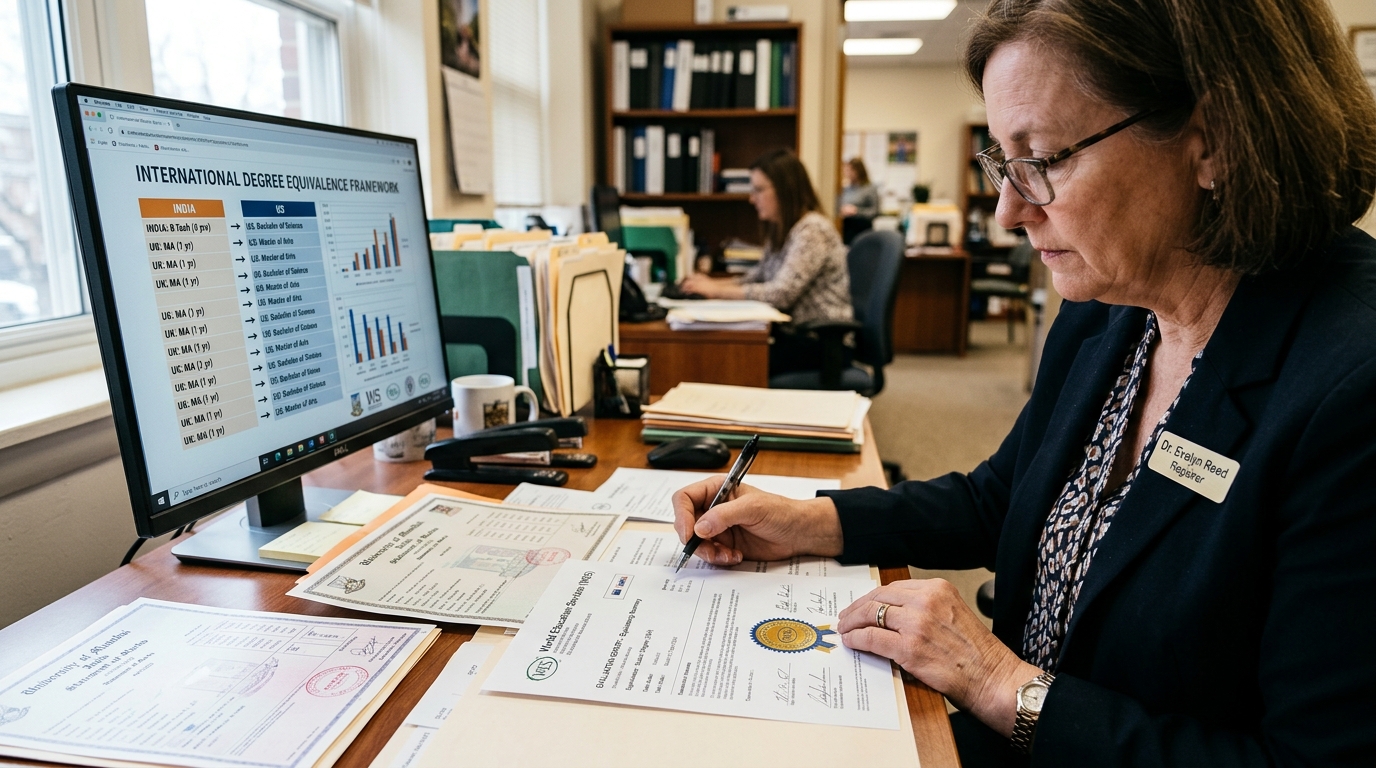
An academic credential evaluation is a formal comparative process whereby an accredited organization evaluates your international curriculum, completed credit hours, grading scales, and the standing of your home institution to determine its exact equivalence within the U.S. higher education system (e.g., verifying whether your degree equals a U.S. Bachelor’s Degree or a U.S. Master’s Degree).
Foreign-educated professionals generally require a credential evaluation for three primary reasons:
- Corporate and Professional Employment: Private companies, multinational corporations, and government agencies require formal verification that your international degree meets standard U.S. job specifications.
- Higher Education and Graduate Admissions: If you plan to pursue a master’s, doctorate, or postgraduate certificate at an American university, admissions committees require the evaluation to verify academic prerequisites and grade point average (GPA).
- Legal Immigration and Work Visas: USCIS mandates a credential evaluation report as decisive evidence when applying for employment-based visas, including the H-1B specialty occupation visa, the EB-2 National Interest Waiver (NIW), or the EB-3 skilled worker green card.
Authorized Evaluation Agencies: Who to Turn To?
Because not just any translation office or private agency is authorized to evaluate academic credentials, it is essential to work with evaluators recognized by national governing associations. The two primary benchmark organizations in the United States are NACES (National Association of Credential Evaluation Services) and AICE (Association of International Credential Evaluators). Choosing an affiliated member guarantees your report will be widely accepted.
Among the most widely requested evaluation providers are:
- WES (World Education Services): The most widely recognized and utilized credential evaluator in North America. Its digital reports are accepted by thousands of colleges, universities, corporate employers, and immigration agencies across both the United States and Canada. WES also maintains direct digital exchange partnerships with hundreds of universities worldwide.
- ECE (Educational Credential Evaluators): Highly respected for its rigorous course analysis and academic depth. It is often the preferred choice for state licensing boards (particularly in nursing, pharmacy, and healthcare fields) as well as universities with strict prerequisite formulas.
- Josef Silny & Associates: Based in Florida, this reputable agency is a favored option for international graduates thanks to its fast turnaround times and comprehensive in-house certified translation and evaluation packages under one roof.
“The single most costly mistake made by foreign professionals is purchasing evaluations from unauthorized agencies lacking NACES credentials. Before paying a single dollar, always confirm with your prospective employer, university board, or immigration attorney which specific agency they mandate.”
— Mariana Cordero, Senior International Academic Mobility Advisor
Evaluation Report Types: Which One Do You Need?
When launching your application with agencies such as WES or ECE, you must select between two primary report types. Picking the wrong format can result in costly re-evaluation delays:
| Evaluation Type | What Does It Contain? | Best Used For |
|---|---|---|
| Document-by-Document | States degree title, institution name, length of study, and assigns the general U.S. equivalency (e.g., Bachelor’s Degree). | USCIS immigration petitions (H-1B, EB-2, EB-3), general corporate employment, and non-specialized job hiring. |
| Course-by-Course | Breaks down every course taken, assigns U.S. semester credit units, and calculates your cumulative Grade Point Average (GPA on a 4.0 scale). | University admissions, graduate school, credit transfers, and state professional licensing boards (Medical, Nursing, Engineering, Bar). |
Required Documents to Start the Process
While specific submission requirements vary depending on your country of education, most NACES agencies require the following core packet:
- Original University Diploma or Degree Certificate: High-resolution color copy proving degree conferral and completion of studies.
- Official Academic Transcripts: Official statement issued by your university registrar itemizing all completed courses, credit hours/class units, individual marks or grades, and graduation date.
- The Hague Apostille or Consular Legalization: While many private evaluators accept direct electronic university verification, an official Apostille remains essential if submitting hard copies to state regulatory boards or judicial bodies.
- Direct University Dispatch vs. Applicant Submission: Crucial Note: Organizations like WES strictly mandate that academic transcripts be sent directly by the issuing university in a sealed, stamped envelope or through secure electronic registrar exchanges. Documents submitted directly by applicants are routinely rejected under anti-fraud safeguards.
The Crucial Role of Certified Translations
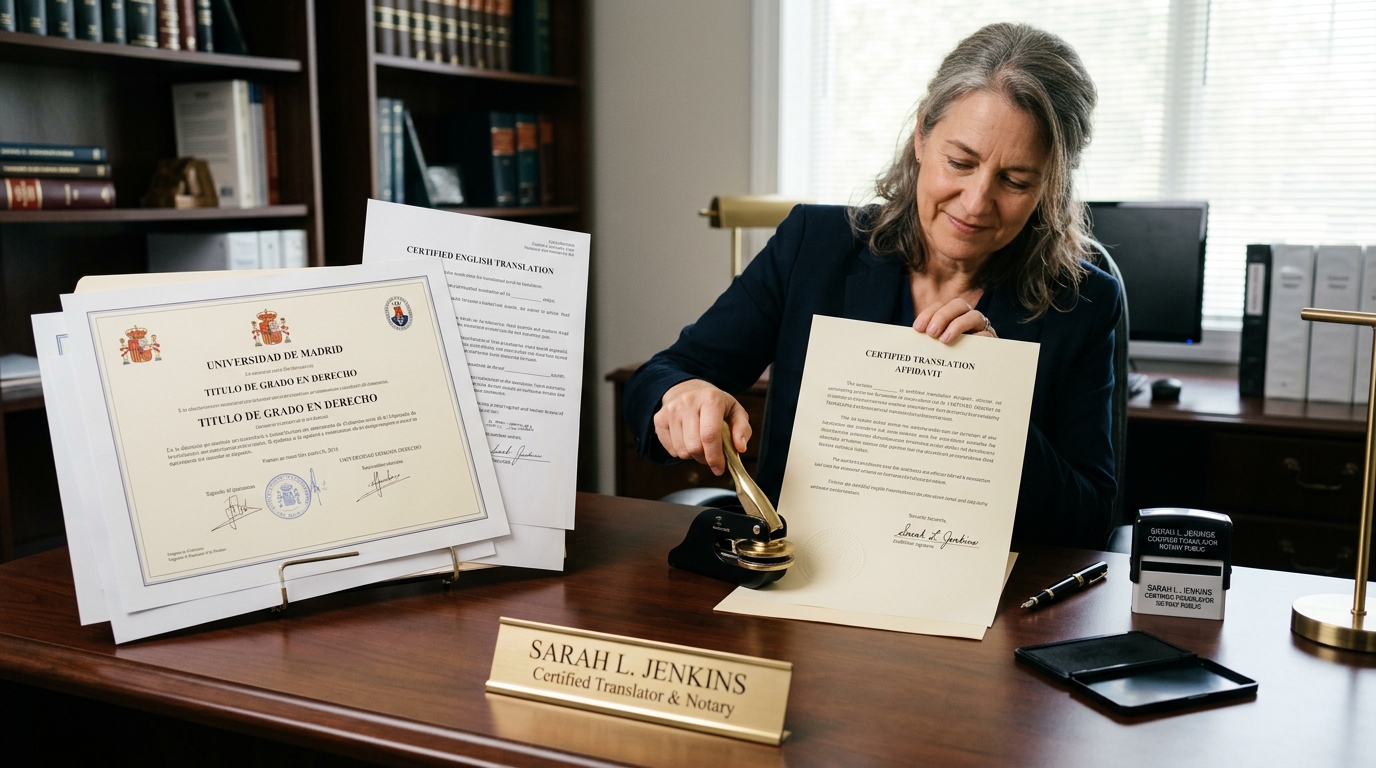
If your educational records, diplomas, and transcripts were originally issued in Spanish or another non-English language, you are legally and procedurally required to submit a Certified English Translation.
Crucially, you cannot translate your own documents, even if you are entirely bilingual or a native English speaker. USCIS standards and NACES regulations dictate that translations must be completed by a qualified professional translator (preferably accredited by the American Translators Association – ATA or a sworn state translator in your home country). The translator must append a signed, dated Affidavit of Accuracy certifying under penalty of perjury that the English version represents an authentic, complete, and faithful translation of the original foreign document.
Regulated vs. Non-Regulated Professions in the United States
Understanding the distinction between regulated and unregulated career fields is critical for mapping your career pathway in the U.S.:

1. Non-Regulated Professions (Tech, Business, Marketing, Design, Finance)
In industries such as computer science, data analysis, marketing, corporate management, human resources, or graphic design, no government occupational license is required. For these career paths, an academic credential evaluation report from a NACES agency is generally all that is needed to validate your degree. Hiring decisions and qualification assessments rest entirely with your prospective corporate employer.
2. Regulated Professions (Medicine, Nursing, Dentistry, Law, Engineering, Psychology)
In professions impacting public health, structural safety, or the legal system, credential evaluation is merely a preliminary baseline. Practicing in these areas requires completing formal State Licensing Board procedures:
- Medicine: Requires credential verification through ECFMG (Educational Commission for Foreign Medical Graduates), passing the USMLE board exams (Step 1 and Step 2 CK), completing a multi-year U.S. hospital residency program, and obtaining a state medical license.
- Nursing: Demands evaluation through bodies like CGFNS, demonstration of English proficiency, and passing the national NCLEX-RN examination to earn Registered Nurse licensure.
- Civil & Structural Engineering: Requires NCEES transcript verification and passing both the FE (Fundamentals of Engineering) and PE (Principles and Practice of Engineering) exams to stamp plans as a licensed Professional Engineer.
- Law: Because the U.S. adheres to Common Law while Latin American nations follow Civil Law, foreign law graduates must typically complete a one-year Master of Laws (LL.M.) at an ABA-accredited law school to qualify for the Bar Exam in permitting jurisdictions such as New York or California.
Step-by-Step Practical Roadmap (WES Example)
To understand how the workflow functions in practice, here is the standard roadmap using World Education Services (WES):
- Create Your Online Profile & Secure a Reference Number: Visit `wes.org`, select the U.S. application portal, and obtain your permanent WES Reference Number. This number must be clearly marked on all correspondence and packages.
- Choose Your Evaluation Package: Select between WES Basic or WES ICAP (which permanently stores your verified transcripts for future orders) and designate Document-by-Document or Course-by-Course based on your goals.
- Pay Required Evaluation Fees: Finalize payment online using an international credit card or electronic payment method.
- Secure Document Submission: Arrange for your foreign university registrar to dispatch official academic transcripts via direct institutional portals or sealed envelopes according to WES country-specific requirements.
- Track Progress & Download Completed Report: Monitor case status online. Once verified, WES issues an official digital evaluation badge and report while dispatching physical copies to your designated recipients.
How Much Does It Cost and How Long Does It Take?
Budgeting for degree evaluation involves several interrelated components:
- Agency Base Fee: A Document-by-Document report generally ranges between $100 and $125 USD. A comprehensive Course-by-Course evaluation costs between $170 and $230 USD (or approximately $250 USD with ICAP permanent repository service).
- Ancillary Expenses: Certified English translations (averaging $25 to $50 USD per page), international expedited courier shipping via DHL/FedEx ($40 to $80 USD), and university transcript processing fees charged by your alma mater.
- Processing Timelines: Once all official records are received and authenticated, standard report preparation requires approximately 5 to 7 business days with WES (or 2 to 3 weeks at other providers). Urgent 24- to 48-hour expedited options are available for an additional $100 to $150 USD surcharge.
Frequently Asked Questions (FAQ) on Degree Validation in the USA
Can I evaluate a technical or associate degree, or only bachelor’s degrees?
Yes, two- and three-year technical degrees, polytechnic certificates, and higher diplomas can be fully evaluated. Accredited agencies assess coursework volume and typically certify technical qualifications as equivalent to a U.S. Associate Degree or transfer semester credit hours toward a bachelor’s program.
Does an academic credential evaluation report ever expire?
No, an academic credential evaluation does not expire. Once your international diploma is officially certified as equivalent to a U.S. educational milestone, that standing remains valid indefinitely. However, institutions or employers may periodically request fresh official copies sent directly from the evaluation agency’s archive.
What can I do if my home university closed and I cannot retrieve my transcripts?
If your alma mater closed its doors or ceased operations, you should contact the Ministry or Department of Education in your home country. By law, government education authorities archive records from defunct educational institutions and can issue certified official transcripts recognized by NACES evaluators.


