

Daily transit across international bridges and ports of entry separating Mexico and the United States has crossed an indelible threshold into total biometric automation. U.S. Customs and Border Protection (CBP) has finalized the installation of its biometric facial comparison architecture across 100% of pedestrian lanes while accelerating vehicle lane deployments, cementing instantaneous facial imaging as standard inspection procedure.
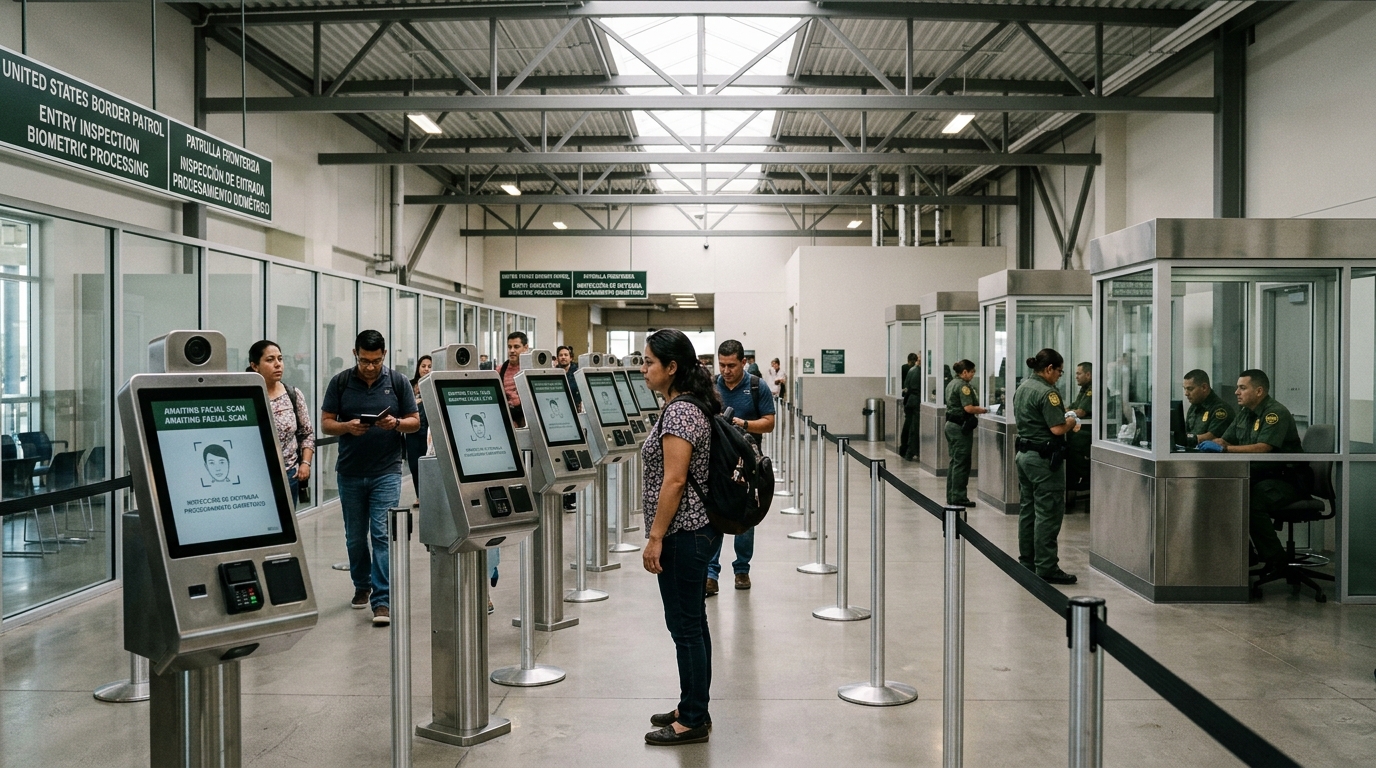
“Facial biometric capture at pedestrian and vehicular lanes establishes a secure entry-exit architecture, eliminating identity loopholes and modernizing border processing without retaining citizen records beyond 12 hours.”
— Technical Directive, U.S. Customs and Border Protection (CBP)
Elimination of Exemptions and Interagency Data Consolidation
Under the standardized regulatory framework, former exemptions for foreign travelers have been abolished, leaving noncitizens without opt-out alternatives. The facial comparison system matches live captures in seconds against official travel galleries. Concurrently, the Department of Homeland Security (DHS) has integrated these real-time feeds across ICE and USCIS platforms to instantly identify overstays and enforcement flags.
Daily Ramifications for Cross-Border Commuters
For hundreds of thousands of border commuters and students traversing twin-city corridors daily, biometric gates have trimmed certain physical bottlenecks while increasing secondary inspection referrals triggered by algorithmic false matches. Civil liberties coalitions caution against expanding surveillance ecosystems that normalize the perpetual tracking of transborder populations.


